Worried Someone You Love May Be Thinking About Suicide?
A practical guide to starting the conversation and helping them find support
If you’re worried that someone you care about may be thinking about suicide, it can be frightening. You might be scared of saying the wrong thing, you might wonder whether you’re overreacting.
You might even be frightened that asking about suicide will somehow make things worse.
Don’t let the fear of getting the conversation perfect stop you from starting it.
You don’t need to diagnose them, counsel them or solve everything that’s happening in their life.
You can notice, ask, listen and you can help them reach appropriate support.
IF SOMEONE'S LIFE IS IN IMMEDIATE DANGER
If someone’s life is in immediate danger call 999 or go to A&E.
If someone has attempted suicide, has seriously harmed themselves, or you believe there is an immediate danger to their life, treat it as an emergency.
If it is safe for you to do so:
- stay with them until help arrives
- remove access to anything they could use to seriously harm themselves
- get emergency help
Don’t leave someone to manage an immediate crisis alone.
How to tell if someone is suicidal
There isn’t always an obvious warning sign. Someone experiencing suicidal thoughts may still go to work, laugh, socialise, play sport and appear to be coping.
However, sometimes you may notice changes in what somebody says or how they behave.
These can include:
- Talking about wanting to die or suicide
- Talking about feeling hopeless, trapped or like a burden
- Becoming withdrawn or unusually quiet
- Significant changes in their usual behaviour
- Increased alcohol or drug use
- Behaving recklessly or taking unusual risks
- Appearing particularly anxious, angry, depressed or hopeless
- Significant changes to sleeping
- Saying goodbye in a way that feels unusual
- Giving possessions away
- Talking repeatedly about death
- A sudden unexplained change in mood after a period of severe distress
These things do not automatically mean somebody is suicidal, and somebody can be suicidal without displaying them.
You don’t need proof before checking in.
If something doesn’t feel right, start a conversation.
Things you could ask to start the conversation
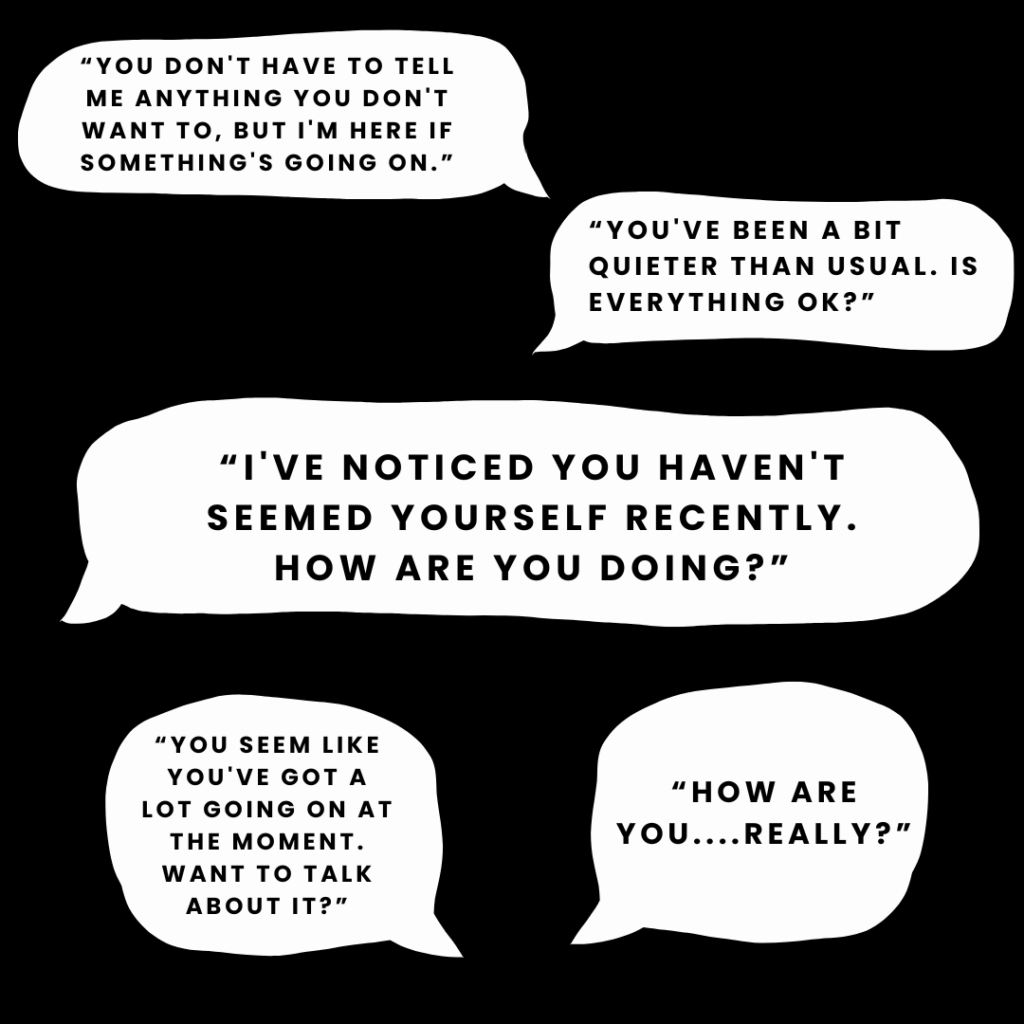
Don't be afraid to say the word suicide
If you’re concerned that they might be thinking about suicide, do ask them directly.
You could say:
“Are you having thoughts of suicide?”
or
“Are you thinking about ending your life?”
It is a myth that asking somebody about suicide will put the idea into their head. Talking openly about suicide can give somebody permission to tell you what they are experiencing and make it easier for them to seek help.
Don’t rely on vague questions such as: “You’re not going to do anything silly, are you?”
Ask clearly, calmly and without judgement.

What if they say "yes" ?
First, try to stay calm. Hearing somebody you love say that they’re thinking about suicide can be frightening and can even bring up emotions like anger and frustration, but this is the moment to listen.
Take them seriously.
Don’t assume that they’re exaggerating, attention-seeking or that they’ll feel differently tomorrow.
Let them talk.
You could say things like:
“Thank you for telling me.”
“I’m listening.”
“You don’t have to deal with this on your own.”
“Let’s work out what support we can get you.”
You don’t have to produce a brilliant answer. When someone feels like this, simply being heard without judgement makes a huge difference.
DO
Ask what would help them feel safer.
They may already have a safety or crisis plan. If they do, ask if you can look at it together.
If they don’t, you can help them think about:
- who they can contact when their thoughts become overwhelming
- places where they feel safer
- people they can stay with
- professional support they can contact
- ways to reduce access to things they might use to harm themselves
Help them connect with support rather than simply handing them a phone number and walking away.
You could say:
“I’ll sit with you while you call.”
“Would you like me to make the call with you?”
“Would you like me to come to the GP with you?”
“Who else would you feel comfortable having here?”
Practical support can make asking for help feel much more manageable.
DON'T
Try to avoid dismissing, judging or making them feel guilty.
Avoid saying things such as:
“You’ve got so much to live for.”
“Other people have it worse.”
“Think about what this would do to your family.”
“But you seem fine.”
“You wouldn’t actually do it.”
“Don’t be silly.”
Don’t describe suicide as selfish. Someone experiencing suicidal thoughts may already feel enormous guilt, shame or hopelessness. Adding guilt is unlikely to help.
What if someone says that they aren't suicidal but I'm still worried?
If you ask someone whether they’re thinking about suicide and they say no, listen to their answer….. but don’t feel that you have to ignore everything that made you concerned in the first place.
There can be many reasons why somebody isn’t ready to talk. They may genuinely not be experiencing suicidal thoughts, or they may feel frightened, embarrassed or unsure about opening up. They might not know how to explain what they’re feeling yet.
Don’t turn the conversation into an interrogation or repeatedly demand a different answer.
Instead, let them know why you asked and leave the door open.
You could say:
“OK. I just wanted to ask because I care about you and I’ve noticed you haven’t seemed yourself lately. If that ever changes, you can tell me.”
Or:
“You don’t have to talk to me, but you don’t have to deal with whatever’s going on by yourself either.”
Trust what you’ve noticed
If you’re still concerned, you can gently explain why:
“I hear what you’re saying. I’m only asking because you’ve seemed really withdrawn recently and some of the things you’ve said have worried me.”
This gives them another opportunity to talk without suggesting that you don’t believe them.
You can also ask more generally:
“Even if you’re not thinking about suicide, are you struggling at the moment?”
“Is there anything you do want to talk about?”
“Would you feel more comfortable talking to somebody else?”
Keep the door open
They might not talk today, but that doesn’t mean today’s conversation was pointless.
Knowing that somebody has noticed and is genuinely willing to listen may make it easier for them to come back to you later.
Continue checking in naturally. Send a message, invite them for a coffee, go for a walk together. Simply keep including them in everyday things.
You could say:
“Just checking in after our conversation the other day. How are you doing today?”
Try not to make every interaction solely about their mental health. Staying connected and knowing somebody cares can matter too.
What if I’m seriously concerned despite them saying no?
A person’s answer is important, but you don’t have to ignore signs of an immediate safety concern simply because they’ve said they’re OK.
If their behaviour, circumstances or something they’ve told you makes you believe there could be an immediate danger to their life, seek emergency help.
In an emergency, call 999 or go to A&E.
In England, if you need urgent mental-health advice but it isn’t an immediate life-threatening emergency, you can call NHS 111 and select the mental health option. You can also contact NHS 111 because you’re worried about somebody else.
Remember
You aren’t expected to determine with certainty whether somebody is suicidal.
Your role isn’t to diagnose them or conduct a risk assessment.
Notice. Ask. Listen. Stay connected. Help them reach appropriate support when they need it.
Sometimes somebody will tell you what’s happening immediately.
Sometimes they won’t.
What matters is that they know the door is open if they decide they’re ready to walk through it.
Looking after yourself too
Supporting someone you love who is experiencing, or may be experiencing, suicidal thoughts can be frightening, emotionally exhausting and overwhelming.
You matter in this situation too.
You may feel anxious about leaving them alone, worried that you’ll say the wrong thing, or as though you’re personally responsible for keeping them safe.
Remember that you don’t have to carry this responsibility by yourself.
Involve appropriate professionals and, where possible, other trusted people so that you have support around you too. Give yourself permission to rest, talk to someone you trust about how you’re feeling (while respecting the other person’s privacy where possible), and continue looking after your own physical and emotional wellbeing. Setting boundaries doesn’t mean you care any less. You cannot be someone’s only source of support.
If the situation begins to affect your own mental health, reach out for professional support for yourself.
Being there for someone doesn’t mean having to do everything alone.
Where to find further help

Your GP can be a good place to start. They can listen to what you’ve been experiencing, discuss the support and treatment that might be appropriate and, where needed, refer you to specialist mental health services.
If you don’t feel comfortable speaking to your usual GP, you can ask to see another doctor at the same practice. You may also be able to register with a different GP surgery if you would prefer.


CALM are the suicide prevention charity that provides life-saving services and practical mental health support to anyone who needs it.
Visit: I feel suicidal | CALM
Call: 0800 58 58 58

SOS Silence of Suicide: A suicide prevention and emotional wellbeing helpline.
If you feel unable to talk about how you are feeling with your friends, family or your Doctor, they are there to talk, listen and support you.